Español
 English
- Not available
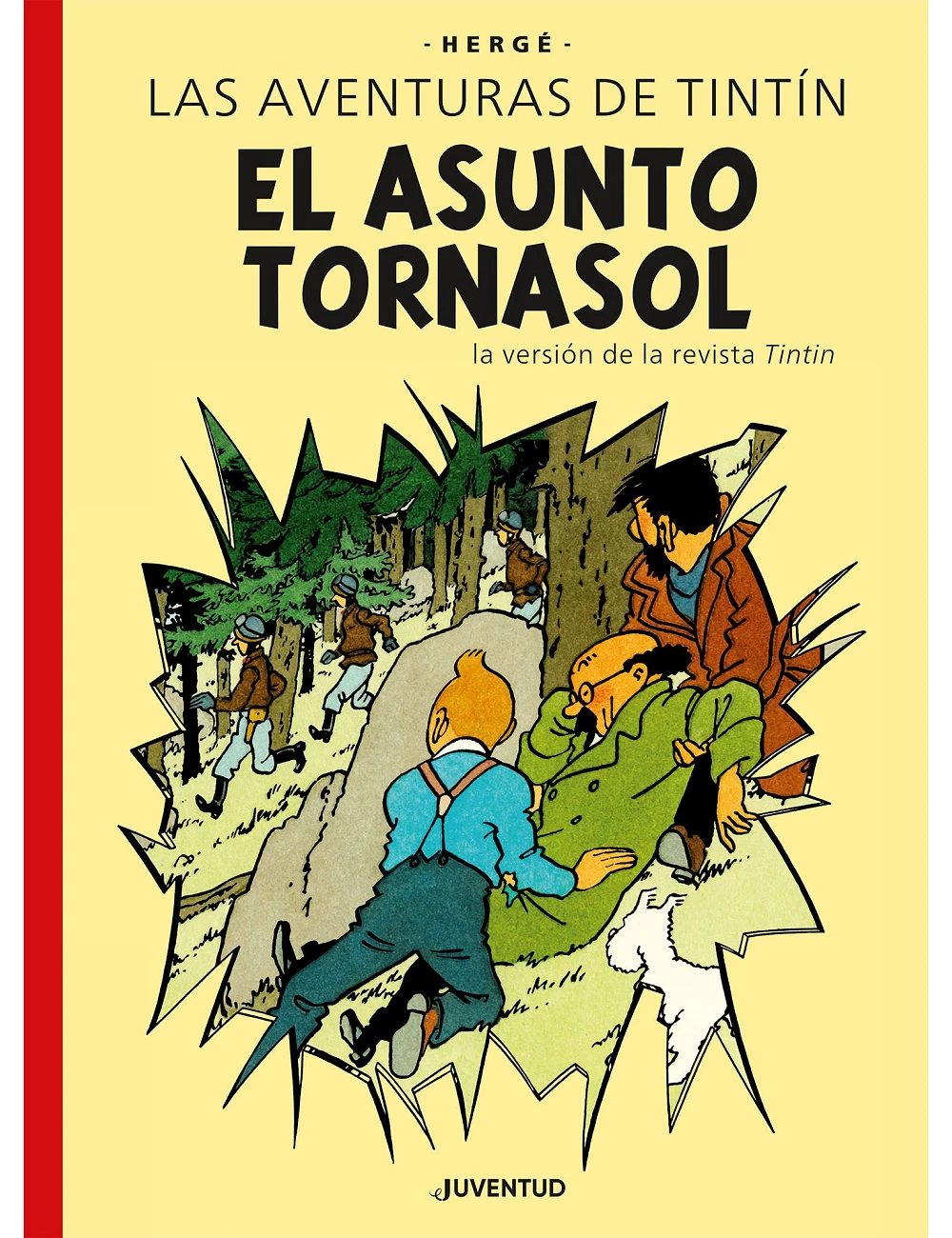

The Calculus Affair. Special Edition of *Journal Tintin*.
In this carefully crafted special edition of * The Calculus Affair*, we revisit—nearly seventy years later—the original version of this adventure, as it appeared in *Tintin* magazine, which differs significantly from the version we’ve known until now, particularly the last twenty panels. Set against the backdrop of the Cold War, this album exquisitely blends elements of spy fiction, satire, and scientific espionage, all with a fast-paced rhythm that once again highlights Hergé’s mastery of the pencil and pen. The Belgian cartoonist’s most Hitchcockian adventure includes an informational booklet that expands on the historical context of this episode and also details the restoration of the original plates and the involvement of the Studios Hergé team. Hergé is the pseudonym of Georges Remi, a play on the reversed initials of his name. Throughout the evolution of his star character, Tintin, we can see the author’s progress: from the early titles marked by the ultra-conservative doctrine of the editor of the newspaper *Le Petit Vingtième* to the breaking of conventions evident starting with *The Blue Lotus*, as well as the evolution of the society of his time. Hergé’s research to provide historical context for his adventures, as well as his implicit social criticism, have made *Tintin* a 20th-century masterpiece.
Translated by Concepción Zendrera
1st edition in this format, October 2026.
Features:
Spanish
Hardcover
96 pages
Dimensions: 24 x 32 cm
The Calculus Affair. Special Edition of *Journal Tintin*.
In this carefully crafted special edition of * The Calculus Affair*, we revisit—nearly seventy years later—the original version of this adventure, as it appeared in *Tintin* magazine, which differs significantly from the version we’ve known until now, particularly the last twenty panels. Set against the backdrop of the Cold War, this album exquisitely blends elements of spy fiction, satire, and scientific espionage, all with a fast-paced rhythm that once again highlights Hergé’s mastery of the pencil and pen. The Belgian cartoonist’s most Hitchcockian adventure includes an informational booklet that expands on the historical context of this episode and also details the restoration of the original plates and the involvement of the Studios Hergé team. Hergé is the pseudonym of Georges Remi, a play on the reversed initials of his name. Throughout the evolution of his star character, Tintin, we can see the author’s progress: from the early titles marked by the ultra-conservative doctrine of the editor of the newspaper *Le Petit Vingtième* to the breaking of conventions evident starting with *The Blue Lotus*, as well as the evolution of the society of his time. Hergé’s research to provide historical context for his adventures, as well as his implicit social criticism, have made *Tintin* a 20th-century masterpiece.
Translated by Concepción Zendrera
1st edition in this format, October 2026.
Features:
Spanish
Hardcover
96 pages
Dimensions: 24 x 32 cm

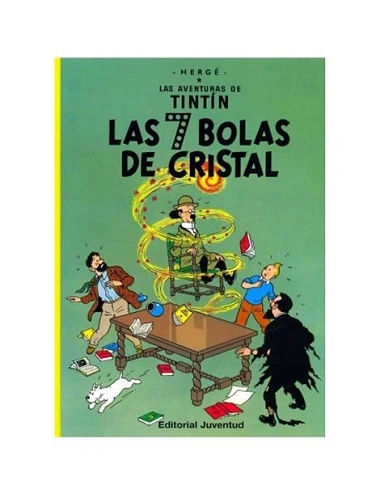
After two years of absence in Peru and Bolivia, the Sanders-Hardmuth ethnographic expedition returns to Europe having discovered several Inca tombs. They brought back the mummy of the Inca Rascar Capac, also called "the one who unleashes fire from the sky", who was wearing valuable solid gold jewelry. After a short time, all the participants of the expedition fall victim to a mysterious evil, and whenever this happens, fragments of small crystal balls are found.
Translated by Concepción Zendrera
23 x 30 cm
Cardboard
64 pages
This album is based on the cartoon film by Raymond Leblanc. The script was written by Greg, and the adaptation of the drawings and dialogues of the film was made by Hergé Studios.
Translated by Concepción Zendrera
23 x 30 cm
Cardboard
48 pages
After reading the news of a airplane crash in the Himalayas, Tintin has a dream where his injured young friend Tchang asks for help half buried in the snow. The next day he learns from the newspaper that Tchang was on the crashed airplane, and that no survivors have been found. But Tintin believes that Tchang is alive and sets off for Kathmandu to organize a rescue expedition. Tintin in Tibet coincides with a period of serious turbulence in Hergé's life, and its creation constituted a real therapy for him that really helped him to overcome it. According to Hergé himself, at that time (1958), he was going through a real crisis and his dreams and nightmares were almost always white. These dreams were always repeated and the author had to go to a psychiatrist who advised him to abandon this work because he would never finish it. Fortunately, Hergé did not do so. Not only did he finish Tintin in Tibet, but, in the opinion of many, it is one of his masterpieces. The color white also reigns in almost all the work, but this time not as a nightmare but as a purification. .
Translated by Concepción Zendrera
23 x 30 cm
Cardboard
64 pages
The Adventures of Tintin. Volume 1
In this first adventure, which began to be published in strips in the children's supplement of the Belgian newspaper Le Vingtième Siècle, Hergé began drawing what would become the most famous reporter of all time: Tintin. For his first trip, he sends him to the land of the Soviets, with the newspaper's desire for anti-communist propaganda, which Hergé would later regret. Upon his return from the former Soviet Union, Hergé is commissioned to send the young reporter to the Congo, then a Belgian colony, and the resulting comic is an excellent representation of the European view of Africa at that time. In the third adventure in this volume, Tintin has to change continents and travel to North America, where he will have to face the terrible Chicago gangster syndicate, including the famous Al Capone. Hergé wanted to show as much of America as possible, such as the diverse landscapes, the big cities and industries, the prohibition of alcoholic beverages, and the plundering of the Native Americans, denouncing the way they were driven from their lands when oil was found there.
This is the first volume of a new commemorative edition that will bring together the 24 comics that make up The Adventures of Tintin in a new compact format, ideal for discovering—or rediscovering—the intrepid adventures of the most famous reporter and his faithful dog. Almost a hundred years after its first publication, Hergé remains one of the greatest icons of European comics. This special edition will not be reprinted beyond this first publication.
22.5 x 29.5 cm
Hardcover
272 pages
Available languages:
Spanish
Tintin and the Art-Alpha, unfinished album, is finally part of the 23 other adventures of Tintin. In the months following Hergé's death on March 3, 1983, speculation was rife: many readers wanted the master's collaborators to finish the story. But Hergé was clear: there would be no new Tintins after him. Finally, in 1986, a luxurious album was published, in two booklets, with the main sketches of the cartoonist. A few years after the publication of Tintin and the Picaros, and shortly before the fiftieth anniversary of his hero, Hergé chose as the setting for his next album the world of contemporary art, which he knew particularly well. He throws Tintin into it without knowing very well where this story was going to lead him. Hergé works sporadically, wishing not to disappoint his readers, but illness overtakes him and soon convinces him that this adventure will never be finished and that it will become Tintin's last adventure.
"If others were to take up Tintin, they might do it better, or worse, but one thing is certain: they would do it differently, and then it would no longer be Tintin" (Hergé).
Translated by Concepción Zendrera
23 x 30 cm
Cardboard
64 pages
The theft of an Arumbaya fetish from the ethnographic museum takes Tintin to the South American republic of San Teodoro. There he is immersed in the war of this country with neighboring Nuevo Rico, and becomes an assistant to General Alcazar, a controversial character that we will meet again later in other adventures. Tintin goes deep into the jungle to find the Arumbayas and discover the mystery of the stolen fetish. This Tintin adventure was first published in Le Petit Vingtième at the end of 1935 and came out in volume in 1937. It was put into color in 1943. Here again, Hergé includes allusions to current world events. The conflict between San Teodoro and Nuevo Rico over oil is based on the bloody Gran Chaco war, which confronted Paraguay and Bolivia during the 1930s and lasted three years, causing more than 100,000 deaths. Hergé is almost absolutely faithful to reality. He converts "el Gran Chaco" to "el Gran Chapo" and transforms the names of two oil companies, but everything else is scrupulously accurate.
In this album Hergé describes the first of his imaginary countries, which he will later make one of his specialties.
Translated by Concepción Zendrera
23 x 30 cm
Cardboard
64 pages
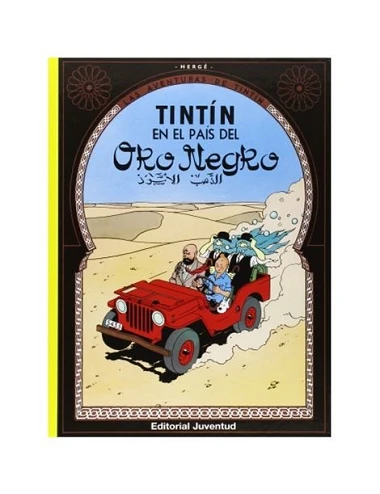
This Tintin adventure is about the struggle between the big oil companies. It all starts when adulterated gasoline invades the market. Tintin travels to the country of Khemed, where a power struggle pits Emir Ben Kalish Ezab against Bab El Ehr, each financed by a different oil company. Enter the terrible Abdalah, the emir's son. Hergé was inspired by a photograph of the real King Faisal II as a child. This album has gone through numerous versions before knowing its final form. It began to appear on September 25, 1939 in Le Petit Vingtième, following King Ottokar's Sceptre, but the war broke out. On May 9, 1940, the German forces entered Brussels and the publication of Le Petit Vingtième was interrupted, and with it, Tintin in land of black gold. The story stops on the current page 26 of the album, and will not be continued until 6 years later in Tintin magazine.
Translated by Concepción Zendrera
23 x 30 cm
Cardboard
64 pages
This second installment of Tintin's lunar adventure was first published in 1954 (15 years before the first manned Apollo 11 moon landing. As in the first part, Destination Moon, Hergé did exhaustive research for the realization of this album. In fact, the realism of these two books led Paris-Match magazine to commission Hergé to illustrate the explanation of the Apollo 12 mission.
Translated by Concepción Zendrera
23 x 30 cm
Cardboard
64 pages
In this adventure, Tintin goes to the center of Africa, to make a report. There, dangerous adventures await him, as his enemies are chasing him to kill him. On Tintin's return from his trip to Russia, described in Tintin in the Land of the Soviets, Hergé is commissioned to take Tintin to the Congo, then a Belgian colony. This album is an excellent document to see how Europeans of the time imagined Africa and Africans. The story was first published on June 5, 1930 in Le Petit Vingtième (see Hergé's biography). In 1946, Hergé completely redrew the album to change it to color and reduce its 110 original plates to the 62 pages that the albums would have from then on. In this new color version, he introduced numerous modifications, softening the colonialist overtones a bit. In spite of this, Tintin in the Congo fell out of favor from the 1950s onwards, and became quite difficult to find. It was the troubled time of decolonization, and the album was not particularly timely. But curiously it was in a Zaire magazine that the story first reappeared, ending the quarantine of Tintin in the Congo.
Translated by Concepción Zendrera
23 x 30 cm
Cardboard
64 pages
When Tintin picks up a wallet forgotten in a bank, he cannot imagine that it will lead him to the country of Syldavia, located in the center of the Balkans. There he learns that there is a conspiracy to steal the scepter of the king, Muskar XII, without which he can no longer reign. And his neighboring country, Borduria, has clear invasion intentions. The plot is clearly influenced by the period. The story was published in Le Petit Vingtième from August 4, 1938 to August 10 of the following year. The signs heralding World War II were numerous and Hitler's Germany was preparing the invasion of Austria, which was annexed and became another province of the Third Reich. We see in King Ottokar's Sceptre how Borduria tries to annex the country of Syldavia, with the help of a certain Musstler, (whose name is a composition of Hitler and Mussolini). The Bordurians can be identified with the Nazis in many aspects: the names, the uniforms, the airairplanes and by their tactics of infiltration in Syldavia. In 1947 the album was redesigned in color.
Translated by Concepción Zendrera
23 x 30 cm
Cardboard
64 pages
La Castafiore announces her arrival in Moulinsart, and the captain tries to flee the trip in a hurry, but stumbles on a broken step that they have not yet come to fix and breaks his ligaments. The rumor of a sentimental relationship between the singer and the "old sea dog" is born and everything is full of paparazzi. And the jewels disappear... In this album there are no travels or great adventures, and that is the grace of Hergé to maintain the intrigue. All the action takes place in Moulinsart, in and around the gardens of the castle. As Hergé himself tells us: "When I started this album, my intention was also to simplify, to train myself to tell, this time, a story in which nothing happens, without resorting to exoticism. Simply to see if I could keep the reader in suspense until the end.
Translated by Concepción Zendrera
23 x 30 cm
Cardboard
64 pages
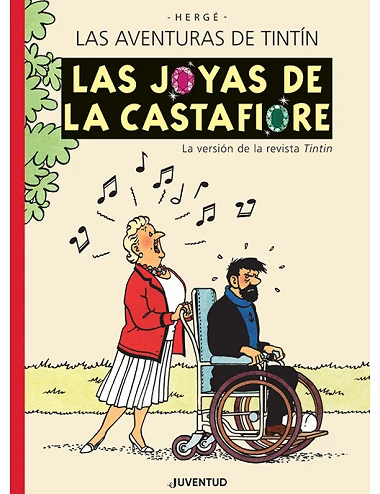
THE JEWELS OF CASTAFIORE - Journal Tintin special edition.
In the early sixties, The Adventures of Tintin was beginning to reap success. Hergé, who was beginning to pay special attention to contemporary art, decided to break the creative rules and do something surprising. And he succeeded. Before conceiving the definitive album edition, known all over the world, the cartoonist had produced a first version published in Tintin magazine, the originals of which had been lying in the archives for 60 years. Carefully and meticulously restored, these documents allow us today to show the public The Jewels of the Castafiore as it appeared in its entirety, between 1961 and 1962, in the weekly magazine for young people from 7 to 77 years old.
Characteristics:
Cardboard binding
80 pages
Size: 24 x 32 cm
1st edition, November 2023
Slave and arms trafficking are at the core of the plot of this adventure, and as usual, Tintin and the captain are involved by a series of coincidences. This album is a sort of continuation of Tintin in land of black gold, and a large number of characters that appeared in previous episodes reappear in it. The emir Ben Kalishn Ezab, in difficulties in his country, sends his little son, the terrible Abdalah to Moulinsart. Tintin and the captain flee from his mischief, leaving him with the long-suffering Nestor, and head for Khemed to try to help the emir.
Translated by Concepción Zendrera
23 x 30 cm
Cardboard
64 pages
This album marks a return to adventure. It begins to appear in the weekly Tintin, in September 1966, four years after the end of The Castafiore Emerald. Here we meet again Rastatopoulos, whom we thought drowned at the end of The Red Sea Sharks, and his friend Allan. A new figurine appears: the very rich Lazlo Carreras, the man who never laughs. Carreiras is a millionaire owner of airairplanes, oil companies and the Sani-Cola beverage. This character was inspired by Marcel Dassault. He is a paradoxical character: he is among the good guys, but under the effect of the truth serum he is portrayed as a being without scruples when it comes to having amassed his fortune. Towards the end of the story we discover Mik Ezdaditoff, a character inspired by Jacques Bergier, author of the book Le Matin des magiciens and animator of the magazine Planète. We see here Hergé's fascination with paranormal and extraterrestrial phenomena.
Translated by Concepción Zendrera
23 x 30 cm
Cardboard
64 pages
Tintin travels on a cruise ship bound for the Far East. On board he meets the strange Egyptologist Philemon Cyclone, who is traveling in search of the tomb of the Egyptian pharaoh Kih-Oskh. Tintin accompanies him to the tomb and there he discovers the mysterious cigars, which hide more than just tobacco. He is then kidnapped and abandoned at sea, but is saved and lands in Arabia. After numerous vicissitudes he ends up in India, where he stays with the Maharaja of Rawhajpurtalah. Here appear characters that we will meet again later: the ineffable policemen Thomson and Thompson, the evil Rastapopoulos and the peculiar Oliveira de Salazar. Cigars of the Pharaoh begin to appear in Le petit Vingtiéme on December 8, 1932. It was the time when the news of the curse of Tutankhamun's tomb occupied many pages of the tabloids. This subject interested Hergé so much that years later he raised it again in The Seven Crystal Balls.
Translated by Concepción Zendrera
23 x 30 cm
Cardboard
64 pages
The Calculus Affair. Special Edition of *Journal Tintin*.
In this carefully crafted special edition of * The Calculus Affair*, we revisit—nearly seventy years later—the original version of this adventure, as it appeared in *Tintin* magazine, which differs significantly from the version we’ve known until now, particularly the last twenty panels. Set against the backdrop of the Cold War, this album exquisitely blends elements of spy fiction, satire, and scientific espionage, all with a fast-paced rhythm that once again highlights Hergé’s mastery of the pencil and pen. The Belgian cartoonist’s most Hitchcockian adventure includes an informational booklet that expands on the historical context of this episode and also details the restoration of the original plates and the involvement of the Studios Hergé team. Hergé is the pseudonym of Georges Remi, a play on the reversed initials of his name. Throughout the evolution of his star character, Tintin, we can see the author’s progress: from the early titles marked by the ultra-conservative doctrine of the editor of the newspaper *Le Petit Vingtième* to the breaking of conventions evident starting with *The Blue Lotus*, as well as the evolution of the society of his time. Hergé’s research to provide historical context for his adventures, as well as his implicit social criticism, have made *Tintin* a 20th-century masterpiece.
Translated by Concepción Zendrera
1st edition in this format, October 2026.
Features:
Spanish
Hardcover
96 pages
Dimensions: 24 x 32 cm