Español
 English
- Not available
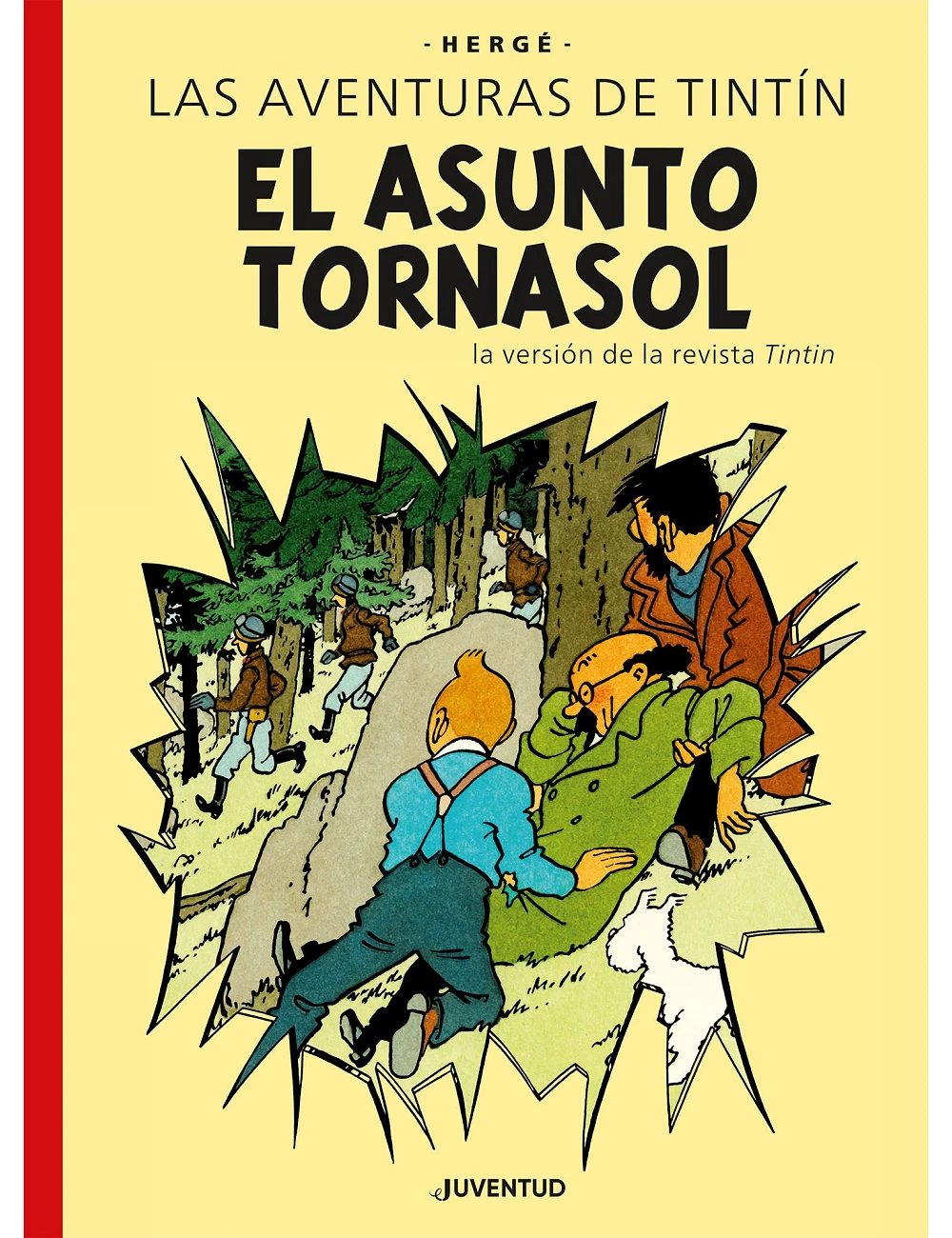

The Calculus Affair. Special Edition of *Journal Tintin*.
In this carefully crafted special edition of * The Calculus Affair*, we revisit—nearly seventy years later—the original version of this adventure, as it appeared in *Tintin* magazine, which differs significantly from the version we’ve known until now, particularly the last twenty panels. Set against the backdrop of the Cold War, this album exquisitely blends elements of spy fiction, satire, and scientific espionage, all with a fast-paced rhythm that once again highlights Hergé’s mastery of the pencil and pen. The Belgian cartoonist’s most Hitchcockian adventure includes an informational booklet that expands on the historical context of this episode and also details the restoration of the original plates and the involvement of the Studios Hergé team. Hergé is the pseudonym of Georges Remi, a play on the reversed initials of his name. Throughout the evolution of his star character, Tintin, we can see the author’s progress: from the early titles marked by the ultra-conservative doctrine of the editor of the newspaper *Le Petit Vingtième* to the breaking of conventions evident starting with *The Blue Lotus*, as well as the evolution of the society of his time. Hergé’s research to provide historical context for his adventures, as well as his implicit social criticism, have made *Tintin* a 20th-century masterpiece.
Translated by Concepción Zendrera
1st edition in this format, October 2026.
Features:
Spanish
Hardcover
96 pages
Dimensions: 24 x 32 cm
The Calculus Affair. Special Edition of *Journal Tintin*.
In this carefully crafted special edition of * The Calculus Affair*, we revisit—nearly seventy years later—the original version of this adventure, as it appeared in *Tintin* magazine, which differs significantly from the version we’ve known until now, particularly the last twenty panels. Set against the backdrop of the Cold War, this album exquisitely blends elements of spy fiction, satire, and scientific espionage, all with a fast-paced rhythm that once again highlights Hergé’s mastery of the pencil and pen. The Belgian cartoonist’s most Hitchcockian adventure includes an informational booklet that expands on the historical context of this episode and also details the restoration of the original plates and the involvement of the Studios Hergé team. Hergé is the pseudonym of Georges Remi, a play on the reversed initials of his name. Throughout the evolution of his star character, Tintin, we can see the author’s progress: from the early titles marked by the ultra-conservative doctrine of the editor of the newspaper *Le Petit Vingtième* to the breaking of conventions evident starting with *The Blue Lotus*, as well as the evolution of the society of his time. Hergé’s research to provide historical context for his adventures, as well as his implicit social criticism, have made *Tintin* a 20th-century masterpiece.
Translated by Concepción Zendrera
1st edition in this format, October 2026.
Features:
Spanish
Hardcover
96 pages
Dimensions: 24 x 32 cm

This time, Tintin sets out on a journey to Scotland on the trail of evildoers. He discovers the secret behind the walls of the castle of Ben More, on the Black Isle, and its mysterious monster. The Black Island appeared in Le Petit Vingtième from April 15, 1937 to June 16, 1938. The album was first published at the end of 1938 in black and white. In 1943 it was changed to color, reducing the number of pages to 62. In 1965, when the English translation was made, the British publisher pointed out to Hergé numerous errors that this volume contained from the English point of view. Hergé sent his collaborator Bob de Moor to England with the list of errors and the assignment to rejuvenate and authenticate the story. Thus Black Island was completely redrawn and modernized. It should be noted that already in the 1937 edition a television set appears, and although the first essays date from 1923, it was still a relatively confidential invention at that time.
Translated by Concepción Zendrera
23 x 30 cm
Cardboard
64 pages
La Castafiore announces her arrival in Moulinsart, and the captain tries to flee the trip in a hurry, but stumbles on a broken step that they have not yet come to fix and breaks his ligaments. The rumor of a sentimental relationship between the singer and the "old sea dog" is born and everything is full of paparazzi. And the jewels disappear... In this album there are no travels or great adventures, and that is the grace of Hergé to maintain the intrigue. All the action takes place in Moulinsart, in and around the gardens of the castle. As Hergé himself tells us: "When I started this album, my intention was also to simplify, to train myself to tell, this time, a story in which nothing happens, without resorting to exoticism. Simply to see if I could keep the reader in suspense until the end.
Translated by Concepción Zendrera
23 x 30 cm
Cardboard
64 pages
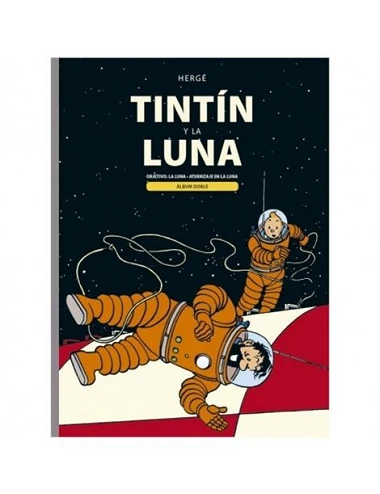
The Adventures of Tintin - Tintin And The Moon, Double Album
Special edition of the double adventure of Tintin on the Moon on the occasion of the 50th anniversary of the arrival of man on the Moon, although Tintin stepped on the lunar surface 14 years earlier. This book is made up of the two installments that narrate the space voyage created by Hergé in Destination Moon and Explorers on the Moon. This double album brings together the two original adventures in the usual format of the albums published by Juventud, but in a single volume with both comics. The edition has the original translation by Concepción Zendrera into Spanish.
Characteristics:
Edition: May 2019 (first)
Cardboard
Measurements: 22.5 x 30.5 cm.
Pages: 128
When Tintin picks up a wallet forgotten in a bank, he cannot imagine that it will lead him to the country of Syldavia, located in the center of the Balkans. There he learns that there is a conspiracy to steal the scepter of the king, Muskar XII, without which he can no longer reign. And his neighboring country, Borduria, has clear invasion intentions. The plot is clearly influenced by the period. The story was published in Le Petit Vingtième from August 4, 1938 to August 10 of the following year. The signs heralding World War II were numerous and Hitler's Germany was preparing the invasion of Austria, which was annexed and became another province of the Third Reich. We see in King Ottokar's Sceptre how Borduria tries to annex the country of Syldavia, with the help of a certain Musstler, (whose name is a composition of Hitler and Mussolini). The Bordurians can be identified with the Nazis in many aspects: the names, the uniforms, the airairplanes and by their tactics of infiltration in Syldavia. In 1947 the album was redesigned in color.
Translated by Concepción Zendrera
23 x 30 cm
Cardboard
64 pages
A meteorite is heading towards the earth and many are predicting the end of the world. Tintin goes to the astronomical observatory where he meets Professor Calys. Fortunately, the omens are not fulfilled and only a fragment of the meteorite reaches the earth, falling into the Arctic Ocean. When he notices the presence of an unknown element, Professor Calys organizes an expedition on the ship Aurora, in which Tintin and Captain Haddock take part. The Shooting Star will be the first album already designed in color and was published in 1942.
Translated by Concepción Zendrera
23 x 30 cm
Cardboard
64 pages
After reading the news of a airplane crash in the Himalayas, Tintin has a dream where his injured young friend Tchang asks for help half buried in the snow. The next day he learns from the newspaper that Tchang was on the crashed airplane, and that no survivors have been found. But Tintin believes that Tchang is alive and sets off for Kathmandu to organize a rescue expedition. Tintin in Tibet coincides with a period of serious turbulence in Hergé's life, and its creation constituted a real therapy for him that really helped him to overcome it. According to Hergé himself, at that time (1958), he was going through a real crisis and his dreams and nightmares were almost always white. These dreams were always repeated and the author had to go to a psychiatrist who advised him to abandon this work because he would never finish it. Fortunately, Hergé did not do so. Not only did he finish Tintin in Tibet, but, in the opinion of many, it is one of his masterpieces. The color white also reigns in almost all the work, but this time not as a nightmare but as a purification. .
Translated by Concepción Zendrera
23 x 30 cm
Cardboard
64 pages
The publication of the adventures of Tintin, reporter of the Petit Vingtième in the land of the Soviets, began on January 10, 1929 in the children's supplement of the Belgian newspaper Le Vingtième Siècle, in the form of single pages, in black and white as the present edition. In 1930 they were expanded in an album with which Hergé started the collection of the Adventures of Tintin, showing what in the future would be his way of doing both in drawings and in scripts and "gags", and that he would perfect in the following adventures.
Translated by Concepción Zendrera
23 x 30 cm
Cardboard
Tintin and the Art-Alpha, unfinished album, is finally part of the 23 other adventures of Tintin. In the months following Hergé's death on March 3, 1983, speculation was rife: many readers wanted the master's collaborators to finish the story. But Hergé was clear: there would be no new Tintins after him. Finally, in 1986, a luxurious album was published, in two booklets, with the main sketches of the cartoonist. A few years after the publication of Tintin and the Picaros, and shortly before the fiftieth anniversary of his hero, Hergé chose as the setting for his next album the world of contemporary art, which he knew particularly well. He throws Tintin into it without knowing very well where this story was going to lead him. Hergé works sporadically, wishing not to disappoint his readers, but illness overtakes him and soon convinces him that this adventure will never be finished and that it will become Tintin's last adventure.
"If others were to take up Tintin, they might do it better, or worse, but one thing is certain: they would do it differently, and then it would no longer be Tintin" (Hergé).
Translated by Concepción Zendrera
23 x 30 cm
Cardboard
64 pages
Slave and arms trafficking are at the core of the plot of this adventure, and as usual, Tintin and the captain are involved by a series of coincidences. This album is a sort of continuation of Tintin in land of black gold, and a large number of characters that appeared in previous episodes reappear in it. The emir Ben Kalishn Ezab, in difficulties in his country, sends his little son, the terrible Abdalah to Moulinsart. Tintin and the captain flee from his mischief, leaving him with the long-suffering Nestor, and head for Khemed to try to help the emir.
Translated by Concepción Zendrera
23 x 30 cm
Cardboard
64 pages
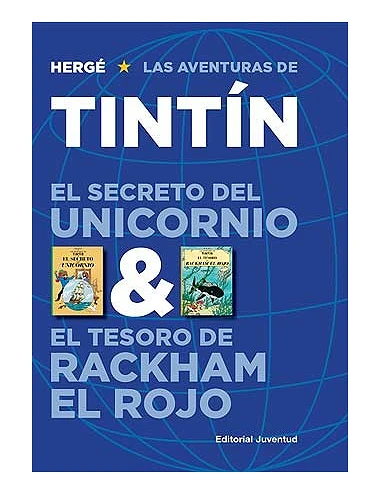
The Secret of the Unicorn & The Treasure of Rackham the Red (Double Album)
Tintin buys a model of an old galleon at the old market. It turns out to be a replica of the ship that governed the ancestor of Captain Haddock, the knight Hadoque, who fought against the pirate Rackham the Red, who carried on his ship a great treasure that has been hidden for centuries. This book includes the two albums of Tintin's adventures, The Secret of the Unicorn and The Treasure of Rackham the Red, in a single volume.
Measurements: 19.5 x 26 cm
Cardboard
128 pages
Languages available:
English
This is a comic masterpiece. We prefer not to explain the plot of the story here, so that those who read it for the first time can fully enjoy it. From the very beginning, the events are chained together at a fast pace: an explosion is heard, a storm breaks out, objects break, the power goes out and Serafin Brass arrives for the first time in the series. There will be virtually no downtime in the entire story. For the creation of the sets, Hergé wanted to be as precise as possible. The story, which takes place mostly in Switzerland, reflects the Cold War, which was going through very tense moments between the two blocs, represented in the rivalry between Borduria and Syldavia. The Calculus Affair was published in 1956.
Translated by Concepción Zendrera
23 x 30 cm
Cardboard
64 pages
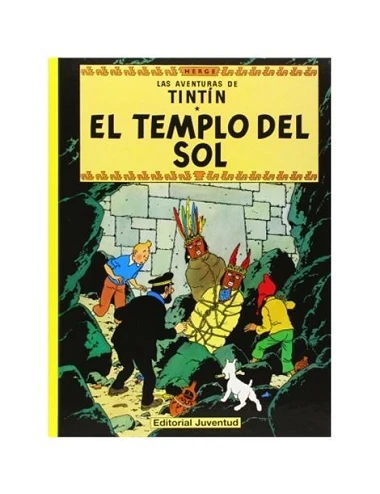
Tintin and Captain Haddock accompanied by the inseparable Snowy have traveled to Peru in search of Professor Calculus, who has been kidnapped for having dared to wear the bracelet of the Inca mummy Rascar Capac. Tintin discovers the professor on the freighter Pachamac, but is unable to free him. The clues will lead them on a long journey in the company of Zorrino, an Indian boy, through the Andes mountains and the jungle to a secret temple of the Incas.
Translated by Concepción Zendrera
23 x 30 cm
Cardboard
64 pages
In this adventure, Tintin goes to the center of Africa, to make a report. There, dangerous adventures await him, as his enemies are chasing him to kill him. On Tintin's return from his trip to Russia, described in Tintin in the Land of the Soviets, Hergé is commissioned to take Tintin to the Congo, then a Belgian colony. This album is an excellent document to see how Europeans of the time imagined Africa and Africans. The story was first published on June 5, 1930 in Le Petit Vingtième (see Hergé's biography). In 1946, Hergé completely redrew the album to change it to color and reduce its 110 original plates to the 62 pages that the albums would have from then on. In this new color version, he introduced numerous modifications, softening the colonialist overtones a bit. In spite of this, Tintin in the Congo fell out of favor from the 1950s onwards, and became quite difficult to find. It was the troubled time of decolonization, and the album was not particularly timely. But curiously it was in a Zaire magazine that the story first reappeared, ending the quarantine of Tintin in the Congo.
Translated by Concepción Zendrera
23 x 30 cm
Cardboard
64 pages
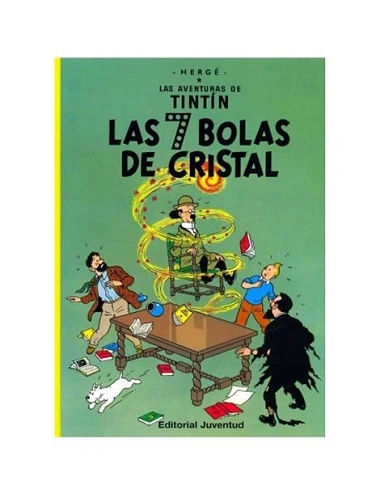
After two years of absence in Peru and Bolivia, the Sanders-Hardmuth ethnographic expedition returns to Europe having discovered several Inca tombs. They brought back the mummy of the Inca Rascar Capac, also called "the one who unleashes fire from the sky", who was wearing valuable solid gold jewelry. After a short time, all the participants of the expedition fall victim to a mysterious evil, and whenever this happens, fragments of small crystal balls are found.
Translated by Concepción Zendrera
23 x 30 cm
Cardboard
64 pages
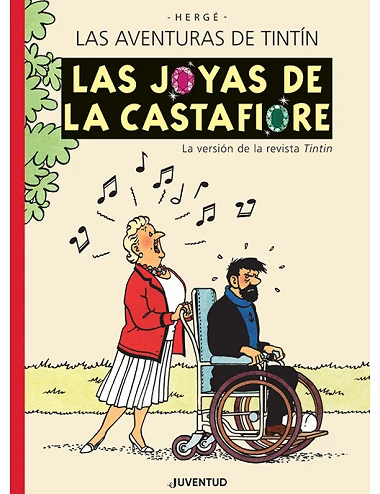
THE JEWELS OF CASTAFIORE - Journal Tintin special edition.
In the early sixties, The Adventures of Tintin was beginning to reap success. Hergé, who was beginning to pay special attention to contemporary art, decided to break the creative rules and do something surprising. And he succeeded. Before conceiving the definitive album edition, known all over the world, the cartoonist had produced a first version published in Tintin magazine, the originals of which had been lying in the archives for 60 years. Carefully and meticulously restored, these documents allow us today to show the public The Jewels of the Castafiore as it appeared in its entirety, between 1961 and 1962, in the weekly magazine for young people from 7 to 77 years old.
Characteristics:
Cardboard binding
80 pages
Size: 24 x 32 cm
1st edition, November 2023
The Calculus Affair. Special Edition of *Journal Tintin*.
In this carefully crafted special edition of * The Calculus Affair*, we revisit—nearly seventy years later—the original version of this adventure, as it appeared in *Tintin* magazine, which differs significantly from the version we’ve known until now, particularly the last twenty panels. Set against the backdrop of the Cold War, this album exquisitely blends elements of spy fiction, satire, and scientific espionage, all with a fast-paced rhythm that once again highlights Hergé’s mastery of the pencil and pen. The Belgian cartoonist’s most Hitchcockian adventure includes an informational booklet that expands on the historical context of this episode and also details the restoration of the original plates and the involvement of the Studios Hergé team. Hergé is the pseudonym of Georges Remi, a play on the reversed initials of his name. Throughout the evolution of his star character, Tintin, we can see the author’s progress: from the early titles marked by the ultra-conservative doctrine of the editor of the newspaper *Le Petit Vingtième* to the breaking of conventions evident starting with *The Blue Lotus*, as well as the evolution of the society of his time. Hergé’s research to provide historical context for his adventures, as well as his implicit social criticism, have made *Tintin* a 20th-century masterpiece.
Translated by Concepción Zendrera
1st edition in this format, October 2026.
Features:
Spanish
Hardcover
96 pages
Dimensions: 24 x 32 cm