Español
 English
- New


TINTINOSPHERE - LAS JÒIAS DE LA CASTAFIÒRA - GASCÓN
Since December 2025, for the first time in history, *Les Bijoux de la Castafiore*—one of the most unique and beloved albums in *The Adventures of Tintin* series—has been available in the Gascon language, under the title *Las hèitas de Tintin – Las Jòias de la Castafiòra*. This unprecedented edition is the result of a cultural and linguistic project spearheaded by Tintin enthusiasts and advocates of regional languages, with the authorization of the rights holders. The Gascon version was translated by Vincenç Claverie, a translator affiliated with the Acadèmia gasconne de Bayonne-Adour, in collaboration with the local association TintinOsphère.
Since December 2025, for the first time in history, *Les Bijoux de la Castafiore*—one of the most unique and beloved albums in *The Adventures of Tintin* series—has been available in the Gascon language, under the title *Las hèitas de Tintin – Las Jòias de la Castafiòra*. This unprecedented edition is the result of a cultural and linguistic project spearheaded by Tintin enthusiasts and advocates of regional languages, with the authorization of the rights holders. The Gascon version was translated by Vincenç Claverie, a translator affiliated with the Acadèmia gasconne de Bayonne-Adour, in collaboration with the local association TintinOsphère.

Tintin, c'est l'Aventure - N°25* (Special final edition)
WHO ARE THE TINTINS OF TODAY?
Tintin has traveled continents, sailed the oceans, and explored the depths of the sea in search of lost treasure. From the Sahara deserts to the peaks of the Himalayas, from Peruvian solar temples to lunar craters, the world's most famous reporter has shared his love of escape with hundreds of millions of readers.
DISCOVER WITH THIS ISSUE * TINTIN'S WARDROBE
GEO and Éditions Moulinsart revisit the world of Hergé and set off with Tintin to discover today’s world.
Tintin travels to North America, where he confronts the fearsome Chicago gangster syndicate, including the notorious Al Capone. Hergé's initial idea was to build his story around the Redskin Indian village that had always fascinated him, but then he also wanted to show as much of America as possible: the deserts and prairies, modern industries and big cities, alcohol prohibition, gangsters, cowboys and the plundering of the Redskin Indians, denouncing how they were expelled from their lands when oil was found there. Tintin in America began to be published on September 3, 1931 in Le Petit Vingtième, at the rate of two plates per week, where it would be published for a year. As in the case of Tintin in the Congo, the color version of the album was produced in 1945, benefiting from the progress that the practice and experience of these years had given to Hergé, who had already reached a great mastery and mastery in the language of visual storytelling, where the images narrate by themselves, without waiting for the text to do so.
Translated by Concepción Zendrera
23 x 30 cm
Cardboard
64 pages
Les Coulisses D'une Oeuvre Nº 08 - King Ottokar's Sceptre - French.
A new collection has arrived to help you discover how Hergé created The Adventures of Tintin. Each issue of this 23-volume series will be dedicated to an album and will include reproductions of original sketches, annotated plates, as well as detailed analyses of each theme, characters and historical contexts that shaped Hergé's work. It contains exceptional and comprehensive historical content on Hergé's abundant oeuvre. Readers will have the opportunity to see the stages of development of each album from the first drafts to the final drawings, providing an unprecedented insight into Hergé's working method. Preliminary sketches, unfinished sketches and personal comments by the artist.
Size: 25,5x25,5 cm.
Hardcover
Frieze on the spines to reinforce the collection effect.
From 96 to 112 pages depending on the copy.
Language: French
After reading the news of a airplane crash in the Himalayas, Tintin has a dream where his injured young friend Tchang asks for help half buried in the snow. The next day he learns from the newspaper that Tchang was on the crashed airplane, and that no survivors have been found. But Tintin believes that Tchang is alive and sets off for Kathmandu to organize a rescue expedition. Tintin in Tibet coincides with a period of serious turbulence in Hergé's life, and its creation constituted a real therapy for him that really helped him to overcome it. According to Hergé himself, at that time (1958), he was going through a real crisis and his dreams and nightmares were almost always white. These dreams were always repeated and the author had to go to a psychiatrist who advised him to abandon this work because he would never finish it. Fortunately, Hergé did not do so. Not only did he finish Tintin in Tibet, but, in the opinion of many, it is one of his masterpieces. The color white also reigns in almost all the work, but this time not as a nightmare but as a purification. .
Translated by Concepción Zendrera
23 x 30 cm
Cardboard
64 pages
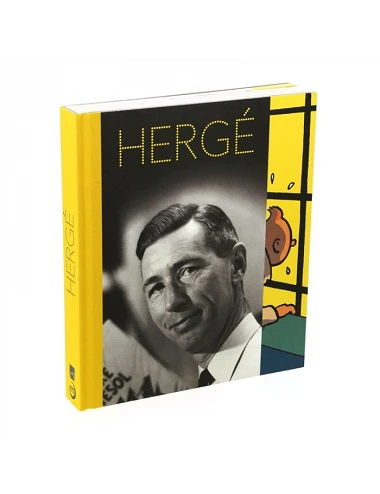
Catalog of the Hergé exhibition at the Grand Palais.
Hergé for the first time at the Grand Palais! This book was published on the occasion of this exhibition designed in collaboration with the Hergé Museum. It offers a joyful immersion in the work of Tintin's father. As early as 1929, the adventures of Tintin were published in Le Petit Vingtième. Georges Remi, alias Hergé, embarks on a fabulous career as an author, both a talented cartoonist and a virtuoso scriptwriter. He creates a style, a line, a school. His notoriety and success will only spread to Belgium, Europe and the world. This book brings together two books in one and provides a new and interactive reading experience. It introduces Hergé, Totor, Tintin, Quick and Flupke and the others..., alternating essays, quotes, documents, leading to a remarkable illustration.
Language: French
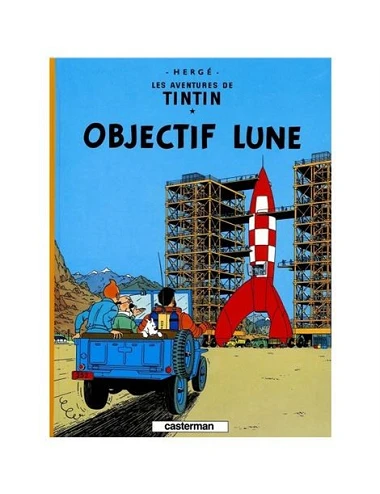
THE ADVENTURES OF TINTIN 16 - OBJECTIF LUNE - FRENCH
This work began to be published in the weekly magazine Tintin on March 30, 1950, nineteen years before the arrival of man on the moon. It is not science fiction but an anticipation as accurate as possible. Hergé contacted Dr. Bernard Heuvelmans, author of the book L'homme parmis les étoiles (Man Among the Stars), a specialist on the subject, who collaborated with the team.
Geo-Tintín C’est L’aventure - La nouvelle conquête de l'espace.
True precursor of the space adventure, Hergé sent Tintin to the Moon more than fifteen years before Neil Armstrong left his mark. Today, the reporter returns to space in the company of the European Space Agency (ESA), to tell us about the new challenges facing humanity in the cosmos. From the return to Earth's satellite to the first steps on Mars, let's take a journey into weightlessness! In the quarterly magazine Tintin c'est l'aventure, GEO and Moulinsart revisit Hergé's universe and set off with Tintin to discover today's world.
(French version)
THE ADVENTURES OF TINTIN 01 - TINTIN AU PAYS DES SOVIETS - FRENCH
The Adventures of Tintin (whose original name, in French, is Les Aventures de Tintin et Milou) is one of the most influential European comic book series of the 20th century. Created by the Belgian author Georges Remi (Hergé), and characteristic of the graphic and narrative style known as "clear line", it consists of a total of 24 albums.
Tintin travels on a cruise ship bound for the Far East. On board he meets the strange Egyptologist Philemon Cyclone, who is traveling in search of the tomb of the Egyptian pharaoh Kih-Oskh. Tintin accompanies him to the tomb and there he discovers the mysterious cigars, which hide more than just tobacco. He is then kidnapped and abandoned at sea, but is saved and lands in Arabia. After numerous vicissitudes he ends up in India, where he stays with the Maharaja of Rawhajpurtalah. Here appear characters that we will meet again later: the ineffable policemen Thomson and Thompson, the evil Rastapopoulos and the peculiar Oliveira de Salazar. Cigars of the Pharaoh begin to appear in Le petit Vingtiéme on December 8, 1932. It was the time when the news of the curse of Tutankhamun's tomb occupied many pages of the tabloids. This subject interested Hergé so much that years later he raised it again in The Seven Crystal Balls.
Translated by Concepción Zendrera
23 x 30 cm
Cardboard
64 pages
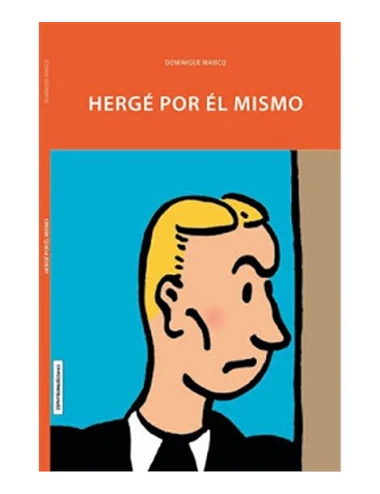
Hergé Por Él Mismo
Portrait Of An Artist Who Was Also A Man: Hergé
Hergé, one of the greatest artists of the 20th century said:
"Tintin was born out of my unconscious desire to be perfect, to be a hero."
What most people ignore is that Hergé handled the pen as well as the brush. A thorough study of Hergé by Dominique Maricq, author of other books such as Les trésors de Tintin. This biography reviews the personality of Georges Remi from letters of correspondence, interview statements or anthologies of his work. The book reveals a man rich in ideas, concepts, thoughts, with a tender humor and full of love and friendship.
Paperback
Language: Spanish
The planet Tintin created by Hergé is a drawn and imaginary world but with a real foundation that, although it belongs, physically, politically, socially, and culturally, to the moment when it was drawn—a worldview that is certainly Eurocentric but inserted in the tradition of travel books—at the same time that it is already history, it transcends, along with its characters, places, situations, and adventures, all time and becomes an archetype worthy of study. Beyond the pleasure they give us as a work of art, in the simple genius of the plots and images, Tintin's travels and landscapes form an “imago mundi” in which each drawing treasures a geography, real or invented, in places that can be located on a more or less identifiable map.
Number of pages: 192
Dimensions: 210 x 130 mm
Exhibition Catalog - Hergé: THE EXHIBITION
Who doesn't know Tintin? But who really knows Hergé? How did Hergé conceive his stories? How did he come up with the idea of drawing a reporter with a toupee? Why did he try his hand at painting? Did Hergé resemble his characters? Why didn't he continue The Adventures of Jo, Zette and Jocko? What is the Hergé style? These and other questions are part of this catalog - or "paper exhibition" - which includes great treasures from the collections of the Hergé Museum: original drawings by the author, sketches, photographs and archival documents. Through a unique journey, we enter the artistic universe of a brilliant and multifaceted artist, capable of using all the media at his disposal to create compositions ranging from illustration to comics, through advertising, press, fashion design and the plastic arts. The lavishly illustrated book includes a prologue by musician Julián Hernández and pages dedicated to the adventures of Tintin and Hergé in Spain by Joan Manuel Soldevilla Albertí, a specialist in Hergé's work. Discover the artist who has captivated millions of readers from 7 to 77 years old all over the world!
Measurements: 24 x 29 cm
64 pages
Cardboard
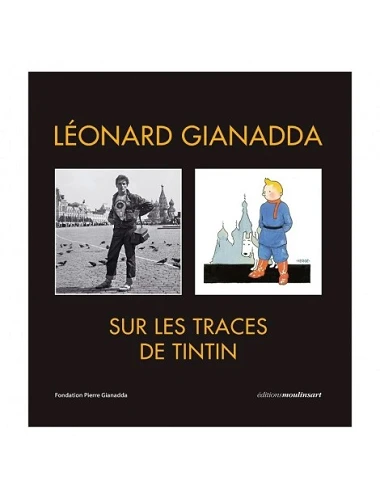
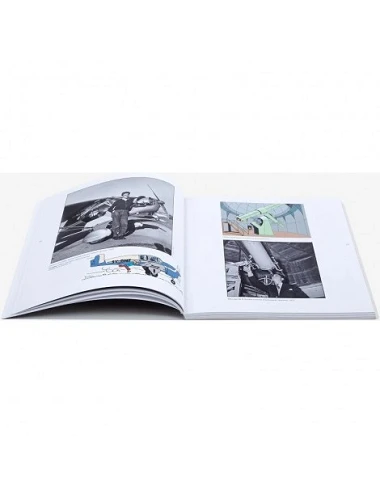
Catalog of the exhibition Léonard Gianadda in the footsteps of Tintin, Galerie du Foyer of the Pierre Gianadda Foundation (Switzerland), from July 12 to November 19, 2024. "When Léonard Gianadda began his reportage that took him to the four corners of the world between 1953 and 1961, the adventures of Tintin were still very much in his memory, if not running in parallel. This may well explain the analogies between Tintin and Leonard Gianadda. "Throughout seven chapters - United States, Europe, Egypt-Morocco, the country of the Soviets, the Mediterranean, South America, Africa - Léonard Gianadda's photographs dialogue with Hergé's drawings.
Hardcover.
Language: French
Images In Action-Discover The Numbers (Castellano)
We inaugurate the collection IMAGES IN ACTION, illustrated didactic books, ideal for the little ones to learn new words with Tintin and Snowy. A full-color illustrated book in which the little ones of the house can discover and learn the numbers through the cartoons of Tintin's adventures. With folding pages and resistant, designed for children from 3 years.
Hard cover.
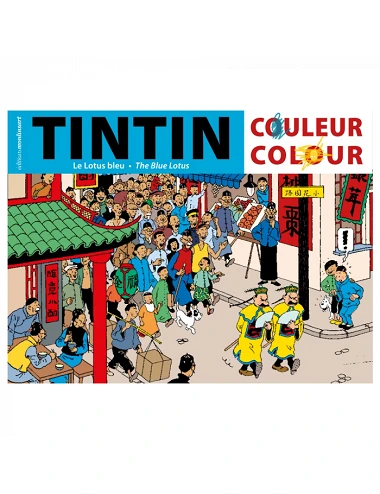
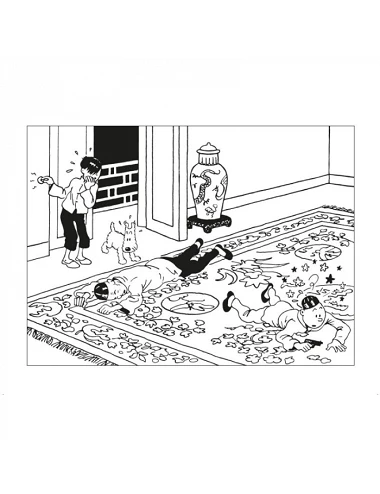
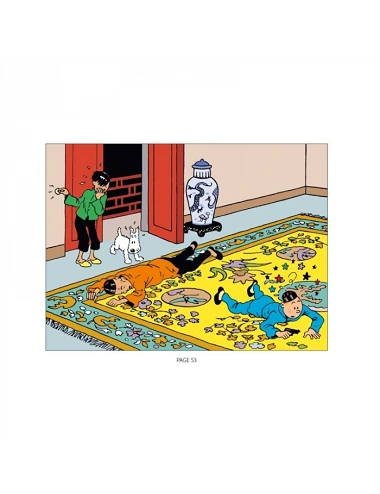
Coloring book. With these sheets, young and old tintinophiles will enjoy painting little pieces of the world created by Hergé. Language: French, Dutch, English.
Year of production: 2025
26 x 34 cm.
TINTINOSPHERE - LAS JÒIAS DE LA CASTAFIÒRA - GASCÓN
Since December 2025, for the first time in history, *Les Bijoux de la Castafiore*—one of the most unique and beloved albums in *The Adventures of Tintin* series—has been available in the Gascon language, under the title *Las hèitas de Tintin – Las Jòias de la Castafiòra*. This unprecedented edition is the result of a cultural and linguistic project spearheaded by Tintin enthusiasts and advocates of regional languages, with the authorization of the rights holders. The Gascon version was translated by Vincenç Claverie, a translator affiliated with the Acadèmia gasconne de Bayonne-Adour, in collaboration with the local association TintinOsphère.