Español
 English
- Not available


The publication of the adventures of Tintin, reporter of the Petit Vingtième in the land of the Soviets, began on January 10, 1929 in the children's supplement of the Belgian newspaper Le Vingtième Siècle, in the form of single pages, in black and white as the present edition. In 1930 they were expanded in an album with which Hergé started the collection of the Adventures of Tintin, showing what in the future would be his way of doing both in drawings and in scripts and "gags", and that he would perfect in the following adventures.
Translated by Concepción Zendrera
23 x 30 cm
Cardboard
The publication of the adventures of Tintin, reporter of the Petit Vingtième in the land of the Soviets, began on January 10, 1929 in the children's supplement of the Belgian newspaper Le Vingtième Siècle, in the form of single pages, in black and white as the present edition. In 1930 they were expanded in an album with which Hergé started the collection of the Adventures of Tintin, showing what in the future would be his way of doing both in drawings and in scripts and "gags", and that he would perfect in the following adventures.
Translated by Concepción Zendrera
23 x 30 cm
Cardboard
64 pages

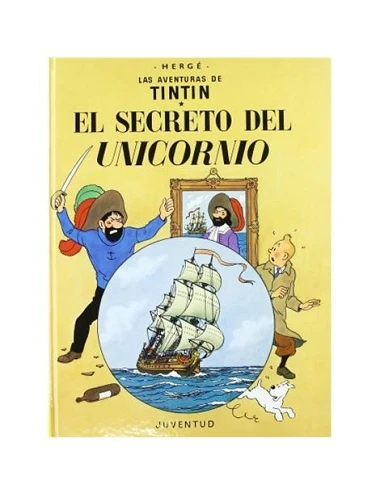
Tintin buys a model of an old galleon at the old market. It turns out to be a replica of the ship that Captain Haddock's ancestor, the knight Hadoque, commanded, who fought against the pirate Rackham the Red, who carried on his ship a great treasure that has been hidden for centuries. This story was first published in Le Soir on June 11, 1942, during the occupation of Belgium, and was one of Hergé's favorite albums. For the design of the Unicorn, Hergé relied on precise documentation of 17th century ships in the Paris Navy Museum.
Translated by Concepción Zendrera
23 x 30 cm
Cardboard
64 pages
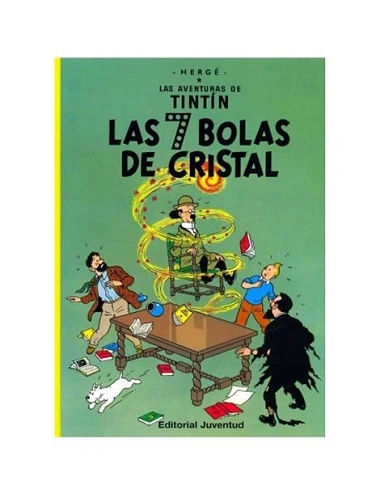
After two years of absence in Peru and Bolivia, the Sanders-Hardmuth ethnographic expedition returns to Europe having discovered several Inca tombs. They brought back the mummy of the Inca Rascar Capac, also called "the one who unleashes fire from the sky", who was wearing valuable solid gold jewelry. After a short time, all the participants of the expedition fall victim to a mysterious evil, and whenever this happens, fragments of small crystal balls are found.
Translated by Concepción Zendrera
23 x 30 cm
Cardboard
64 pages
This work began to be published in the weekly magazine Tintin on March 30, 1950, nineteen years before the arrival of man on the moon. It is not science fiction but an anticipation as accurate as possible. Hergé contacted Dr. Bernard Heuvelmans, author of the book L'homme parmis les étoiles (Man Among the Stars), a specialist on the subject, who collaborated with the team. An extraordinary model of the rocket was made and submitted for the approval of Ananolf, author of the book Astronautics. It was entirely dismountable and allowed the young Bob de Moor, who was mainly responsible for the scenery, to know where the characters were in the spaceship at all times. Hergé has the grace to give a humorous tone to all the scenes of scientific explanations that could bore the reader. Thus, when Wolf and Professor Calculus explain more or less complicated elements, Captain Haddock is there to make us smile with his replies.
Translated by Concepción Zendrera
23 x 30 cm
Cardboard
64 pages
This time, Tintin sets out on a journey to Scotland on the trail of evildoers. He discovers the secret behind the walls of the castle of Ben More, on the Black Isle, and its mysterious monster. The Black Island appeared in Le Petit Vingtième from April 15, 1937 to June 16, 1938. The album was first published at the end of 1938 in black and white. In 1943 it was changed to color, reducing the number of pages to 62. In 1965, when the English translation was made, the British publisher pointed out to Hergé numerous errors that this volume contained from the English point of view. Hergé sent his collaborator Bob de Moor to England with the list of errors and the assignment to rejuvenate and authenticate the story. Thus Black Island was completely redrawn and modernized. It should be noted that already in the 1937 edition a television set appears, and although the first essays date from 1923, it was still a relatively confidential invention at that time.
Translated by Concepción Zendrera
23 x 30 cm
Cardboard
64 pages
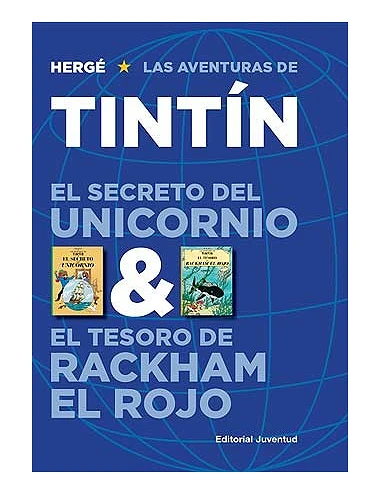
The Secret of the Unicorn & The Treasure of Rackham the Red (Double Album)
Tintin buys a model of an old galleon at the old market. It turns out to be a replica of the ship that governed the ancestor of Captain Haddock, the knight Hadoque, who fought against the pirate Rackham the Red, who carried on his ship a great treasure that has been hidden for centuries. This book includes the two albums of Tintin's adventures, The Secret of the Unicorn and The Treasure of Rackham the Red, in a single volume.
Measurements: 19.5 x 26 cm
Cardboard
128 pages
Languages available:
English
After reading the news of a airplane crash in the Himalayas, Tintin has a dream where his injured young friend Tchang asks for help half buried in the snow. The next day he learns from the newspaper that Tchang was on the crashed airplane, and that no survivors have been found. But Tintin believes that Tchang is alive and sets off for Kathmandu to organize a rescue expedition. Tintin in Tibet coincides with a period of serious turbulence in Hergé's life, and its creation constituted a real therapy for him that really helped him to overcome it. According to Hergé himself, at that time (1958), he was going through a real crisis and his dreams and nightmares were almost always white. These dreams were always repeated and the author had to go to a psychiatrist who advised him to abandon this work because he would never finish it. Fortunately, Hergé did not do so. Not only did he finish Tintin in Tibet, but, in the opinion of many, it is one of his masterpieces. The color white also reigns in almost all the work, but this time not as a nightmare but as a purification. .
Translated by Concepción Zendrera
23 x 30 cm
Cardboard
64 pages
Tintin and the Art-Alpha, unfinished album, is finally part of the 23 other adventures of Tintin. In the months following Hergé's death on March 3, 1983, speculation was rife: many readers wanted the master's collaborators to finish the story. But Hergé was clear: there would be no new Tintins after him. Finally, in 1986, a luxurious album was published, in two booklets, with the main sketches of the cartoonist. A few years after the publication of Tintin and the Picaros, and shortly before the fiftieth anniversary of his hero, Hergé chose as the setting for his next album the world of contemporary art, which he knew particularly well. He throws Tintin into it without knowing very well where this story was going to lead him. Hergé works sporadically, wishing not to disappoint his readers, but illness overtakes him and soon convinces him that this adventure will never be finished and that it will become Tintin's last adventure.
"If others were to take up Tintin, they might do it better, or worse, but one thing is certain: they would do it differently, and then it would no longer be Tintin" (Hergé).
Translated by Concepción Zendrera
23 x 30 cm
Cardboard
64 pages
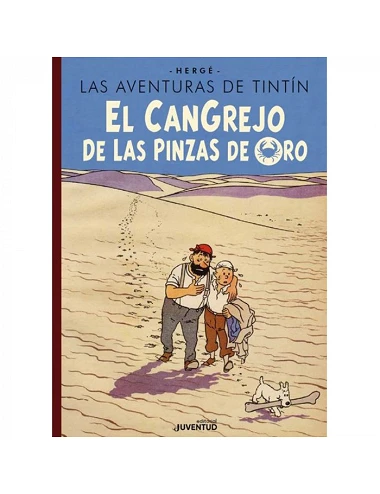
Juventud -Tintin- The Crab With The Golden Claws (Special Edition 80th Anniversary Haddock)
Special edition of the album in Spanish and Catalan of The Crab with the Golden Claws, the first adventure of Tintin in which Captain Haddock appears. This book is presented with eight unpublished pages and in a larger format than the standard comic book.The Crab with the Golden Claws is the ninth adventure devised by Hergé and begins with Tintin following the trail of a mysterious can of crab. Tintin ends up imprisoned on a ship owned by a gang of opium traffickers. There he meets the evil Allan and for the first time Captain Haddock, then a pathetic slave of his addiction to alcohol, a vice that brings countless problems to him and to Tintin who tries to help him. The captain's rehabilitation will come after his forced detoxification during his desert crossing.
This is a special edition published by Editorial Juventud with original translations by Conchita Zendrera (Spanish) and Joaquim Ventalló (Catalan).
Characteristics of the book:
Language: Spanish
Cardboard cover
Measurements: 31'7 x 23'7 cm.
8 extra pages
Year of issue: 2021
A meteorite is heading towards the earth and many are predicting the end of the world. Tintin goes to the astronomical observatory where he meets Professor Calys. Fortunately, the omens are not fulfilled and only a fragment of the meteorite reaches the earth, falling into the Arctic Ocean. When he notices the presence of an unknown element, Professor Calys organizes an expedition on the ship Aurora, in which Tintin and Captain Haddock take part. The Shooting Star will be the first album already designed in color and was published in 1942.
Translated by Concepción Zendrera
23 x 30 cm
Cardboard
64 pages
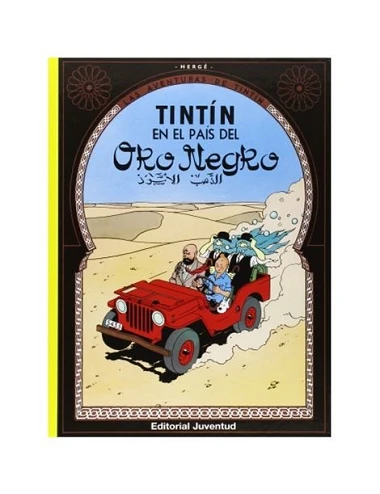
This Tintin adventure is about the struggle between the big oil companies. It all starts when adulterated gasoline invades the market. Tintin travels to the country of Khemed, where a power struggle pits Emir Ben Kalish Ezab against Bab El Ehr, each financed by a different oil company. Enter the terrible Abdalah, the emir's son. Hergé was inspired by a photograph of the real King Faisal II as a child. This album has gone through numerous versions before knowing its final form. It began to appear on September 25, 1939 in Le Petit Vingtième, following King Ottokar's Sceptre, but the war broke out. On May 9, 1940, the German forces entered Brussels and the publication of Le Petit Vingtième was interrupted, and with it, Tintin in land of black gold. The story stops on the current page 26 of the album, and will not be continued until 6 years later in Tintin magazine.
Translated by Concepción Zendrera
23 x 30 cm
Cardboard
64 pages
This is a comic masterpiece. We prefer not to explain the plot of the story here, so that those who read it for the first time can fully enjoy it. From the very beginning, the events are chained together at a fast pace: an explosion is heard, a storm breaks out, objects break, the power goes out and Serafin Brass arrives for the first time in the series. There will be virtually no downtime in the entire story. For the creation of the sets, Hergé wanted to be as precise as possible. The story, which takes place mostly in Switzerland, reflects the Cold War, which was going through very tense moments between the two blocs, represented in the rivalry between Borduria and Syldavia. The Calculus Affair was published in 1956.
Translated by Concepción Zendrera
23 x 30 cm
Cardboard
64 pages
This album is based on the cartoon film by Raymond Leblanc. The script was written by Greg, and the adaptation of the drawings and dialogues of the film was made by Hergé Studios.
Translated by Concepción Zendrera
23 x 30 cm
Cardboard
48 pages
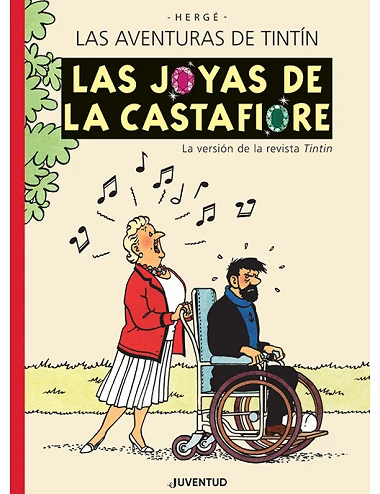
THE JEWELS OF CASTAFIORE - Journal Tintin special edition.
In the early sixties, The Adventures of Tintin was beginning to reap success. Hergé, who was beginning to pay special attention to contemporary art, decided to break the creative rules and do something surprising. And he succeeded. Before conceiving the definitive album edition, known all over the world, the cartoonist had produced a first version published in Tintin magazine, the originals of which had been lying in the archives for 60 years. Carefully and meticulously restored, these documents allow us today to show the public The Jewels of the Castafiore as it appeared in its entirety, between 1961 and 1962, in the weekly magazine for young people from 7 to 77 years old.
Characteristics:
Cardboard binding
80 pages
Size: 24 x 32 cm
1st edition, November 2023
La Castafiore announces her arrival in Moulinsart, and the captain tries to flee the trip in a hurry, but stumbles on a broken step that they have not yet come to fix and breaks his ligaments. The rumor of a sentimental relationship between the singer and the "old sea dog" is born and everything is full of paparazzi. And the jewels disappear... In this album there are no travels or great adventures, and that is the grace of Hergé to maintain the intrigue. All the action takes place in Moulinsart, in and around the gardens of the castle. As Hergé himself tells us: "When I started this album, my intention was also to simplify, to train myself to tell, this time, a story in which nothing happens, without resorting to exoticism. Simply to see if I could keep the reader in suspense until the end.
Translated by Concepción Zendrera
23 x 30 cm
Cardboard
64 pages
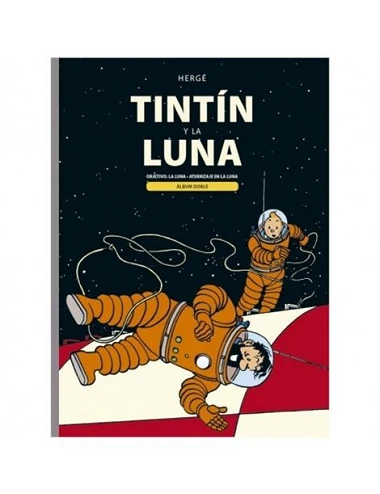
The Adventures of Tintin - Tintin And The Moon, Double Album
Special edition of the double adventure of Tintin on the Moon on the occasion of the 50th anniversary of the arrival of man on the Moon, although Tintin stepped on the lunar surface 14 years earlier. This book is made up of the two installments that narrate the space voyage created by Hergé in Destination Moon and Explorers on the Moon. This double album brings together the two original adventures in the usual format of the albums published by Juventud, but in a single volume with both comics. The edition has the original translation by Concepción Zendrera into Spanish.
Characteristics:
Edition: May 2019 (first)
Cardboard
Measurements: 22.5 x 30.5 cm.
Pages: 128
MUG TAZA TINTÌN - TINTÍN Y HADDOCK LUNA, 47986
Esta taza es parte de la serie Moon, Tintín y Haddock en traje lunar, Tintín trata de atrapar al Capitán Haddock que acaba de salir del Cohete Lunar por capricho. Esta escena es del álbum On a marche sur la lune página 10 C3. Esta taza de porcelana es ideal para todas las bebidas calientes. Lo tendrás bien sujeto en la mano gracias a un amplio mango curvado. Puede lavarse en el lavavajillas y en el microondas. Cada taza está empaquetada en una bonita caja de cartón. Un regalo ideal.
After two years of absence in Peru and Bolivia, the Sanders-Hardmuth ethnographic expedition returns to Europe having discovered several Inca tombs. They brought back the mummy of the Inca Rascar Capac, also called "the one who unleashes fire from the sky", who was wearing valuable solid gold jewelry. After a short time, all the participants of the expedition fall victim to a mysterious evil, and whenever this happens, fragments of small crystal balls are found.
Translated by Concepción Zendrera
23 x 30 cm
Cardboard
64 pages
In this adventure, Tintin goes to the center of Africa, to make a report. There, dangerous adventures await him, as his enemies are chasing him to kill him. On Tintin's return from his trip to Russia, described in Tintin in the Land of the Soviets, Hergé is commissioned to take Tintin to the Congo, then a Belgian colony. This album is an excellent document to see how Europeans of the time imagined Africa and Africans. The story was first published on June 5, 1930 in Le Petit Vingtième (see Hergé's biography). In 1946, Hergé completely redrew the album to change it to color and reduce its 110 original plates to the 62 pages that the albums would have from then on. In this new color version, he introduced numerous modifications, softening the colonialist overtones a bit. In spite of this, Tintin in the Congo fell out of favor from the 1950s onwards, and became quite difficult to find. It was the troubled time of decolonization, and the album was not particularly timely. But curiously it was in a Zaire magazine that the story first reappeared, ending the quarantine of Tintin in the Congo.
Translated by Concepción Zendrera
23 x 30 cm
Cardboard
64 pages
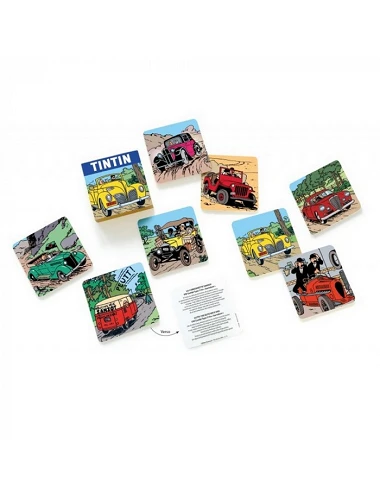
Set of 8 Coasters - Tintin's Cars
Beautiful coasters decorated with images of the cars from The Adventures of Tintin.
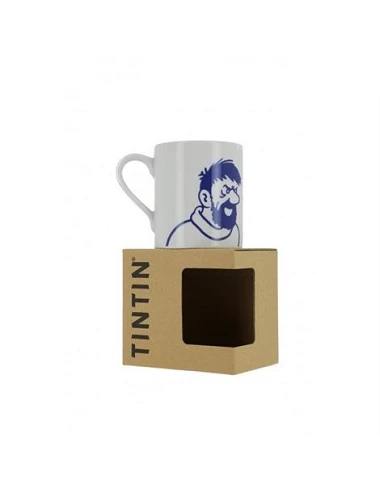
MUG - CHARACTERS - HADDOCK
Ideal mug for tea, coffee or broth for any self-respecting tintinophile. This white mug is decorated with a blue silhouette of Haddock. The captain becomes Tintin's best friend since they meet in The Crab with the Golden Claws, the ninth adventure created by Hergé. Dishwasher and microwave safe. Each mug is packaged in a nice cardboard box.
MOON MAGNET - ROCKET
After escaping from a collision with the asteroid Adonis, the rocket of our friends resumed its trajectory towards the moon. The album On a marche sur la lune, first published in 1954 - Hergé
The publication of the adventures of Tintin, reporter of the Petit Vingtième in the land of the Soviets, began on January 10, 1929 in the children's supplement of the Belgian newspaper Le Vingtième Siècle, in the form of single pages, in black and white as the present edition. In 1930 they were expanded in an album with which Hergé started the collection of the Adventures of Tintin, showing what in the future would be his way of doing both in drawings and in scripts and "gags", and that he would perfect in the following adventures.
Translated by Concepción Zendrera
23 x 30 cm
Cardboard