Español
 English
- Not available


This comic masterpiece, published in 1944, is the continuation of 'The Secret of the Unicorn' and tells the story of the search for the treasure of the pirate Rackham the Red. Professor Calculus enters the scene, the endearing scientist inventor, wise and absent-minded, whom we will meet again in the following adventures of Tintin, and who will become one of his good friends.
Translated by Concepción Zendrera
23 x 30 cm
Cardboard
64 pages
This comic masterpiece, published in 1944, is the continuation of 'The Secret of the Unicorn' and tells the story of the search for the treasure of the pirate Rackham the Red. Professor Calculus enters the scene, the endearing scientist inventor, wise and absent-minded, whom we will meet again in the following adventures of Tintin, and who will become one of his good friends.
Translated by Concepción Zendrera
23 x 30 cm
Cardboard
64 pages

La Castafiore announces her arrival in Moulinsart, and the captain tries to flee the trip in a hurry, but stumbles on a broken step that they have not yet come to fix and breaks his ligaments. The rumor of a sentimental relationship between the singer and the "old sea dog" is born and everything is full of paparazzi. And the jewels disappear... In this album there are no travels or great adventures, and that is the grace of Hergé to maintain the intrigue. All the action takes place in Moulinsart, in and around the gardens of the castle. As Hergé himself tells us: "When I started this album, my intention was also to simplify, to train myself to tell, this time, a story in which nothing happens, without resorting to exoticism. Simply to see if I could keep the reader in suspense until the end.
Translated by Concepción Zendrera
23 x 30 cm
Cardboard
64 pages
The publication of the adventures of Tintin, reporter of the Petit Vingtième in the land of the Soviets, began on January 10, 1929 in the children's supplement of the Belgian newspaper Le Vingtième Siècle, in the form of single pages, in black and white as the present edition. In 1930 they were expanded in an album with which Hergé started the collection of the Adventures of Tintin, showing what in the future would be his way of doing both in drawings and in scripts and "gags", and that he would perfect in the following adventures.
Translated by Concepción Zendrera
23 x 30 cm
Cardboard
This is a comic masterpiece. We prefer not to explain the plot of the story here, so that those who read it for the first time can fully enjoy it. From the very beginning, the events are chained together at a fast pace: an explosion is heard, a storm breaks out, objects break, the power goes out and Serafin Brass arrives for the first time in the series. There will be virtually no downtime in the entire story. For the creation of the sets, Hergé wanted to be as precise as possible. The story, which takes place mostly in Switzerland, reflects the Cold War, which was going through very tense moments between the two blocs, represented in the rivalry between Borduria and Syldavia. The Calculus Affair was published in 1956.
Translated by Concepción Zendrera
23 x 30 cm
Cardboard
64 pages
After reading the news of a airplane crash in the Himalayas, Tintin has a dream where his injured young friend Tchang asks for help half buried in the snow. The next day he learns from the newspaper that Tchang was on the crashed airplane, and that no survivors have been found. But Tintin believes that Tchang is alive and sets off for Kathmandu to organize a rescue expedition. Tintin in Tibet coincides with a period of serious turbulence in Hergé's life, and its creation constituted a real therapy for him that really helped him to overcome it. According to Hergé himself, at that time (1958), he was going through a real crisis and his dreams and nightmares were almost always white. These dreams were always repeated and the author had to go to a psychiatrist who advised him to abandon this work because he would never finish it. Fortunately, Hergé did not do so. Not only did he finish Tintin in Tibet, but, in the opinion of many, it is one of his masterpieces. The color white also reigns in almost all the work, but this time not as a nightmare but as a purification. .
Translated by Concepción Zendrera
23 x 30 cm
Cardboard
64 pages
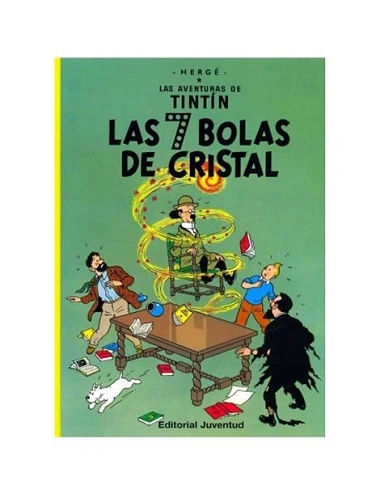
After two years of absence in Peru and Bolivia, the Sanders-Hardmuth ethnographic expedition returns to Europe having discovered several Inca tombs. They brought back the mummy of the Inca Rascar Capac, also called "the one who unleashes fire from the sky", who was wearing valuable solid gold jewelry. After a short time, all the participants of the expedition fall victim to a mysterious evil, and whenever this happens, fragments of small crystal balls are found.
Translated by Concepción Zendrera
23 x 30 cm
Cardboard
64 pages
This album is based on the cartoon film by Raymond Leblanc. The script was written by Greg, and the adaptation of the drawings and dialogues of the film was made by Hergé Studios.
Translated by Concepción Zendrera
23 x 30 cm
Cardboard
48 pages
When Tintin picks up a wallet forgotten in a bank, he cannot imagine that it will lead him to the country of Syldavia, located in the center of the Balkans. There he learns that there is a conspiracy to steal the scepter of the king, Muskar XII, without which he can no longer reign. And his neighboring country, Borduria, has clear invasion intentions. The plot is clearly influenced by the period. The story was published in Le Petit Vingtième from August 4, 1938 to August 10 of the following year. The signs heralding World War II were numerous and Hitler's Germany was preparing the invasion of Austria, which was annexed and became another province of the Third Reich. We see in King Ottokar's Sceptre how Borduria tries to annex the country of Syldavia, with the help of a certain Musstler, (whose name is a composition of Hitler and Mussolini). The Bordurians can be identified with the Nazis in many aspects: the names, the uniforms, the airairplanes and by their tactics of infiltration in Syldavia. In 1947 the album was redesigned in color.
Translated by Concepción Zendrera
23 x 30 cm
Cardboard
64 pages
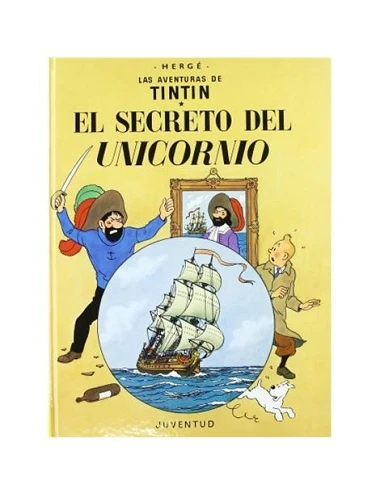
Tintin buys a model of an old galleon at the old market. It turns out to be a replica of the ship that Captain Haddock's ancestor, the knight Hadoque, commanded, who fought against the pirate Rackham the Red, who carried on his ship a great treasure that has been hidden for centuries. This story was first published in Le Soir on June 11, 1942, during the occupation of Belgium, and was one of Hergé's favorite albums. For the design of the Unicorn, Hergé relied on precise documentation of 17th century ships in the Paris Navy Museum.
Translated by Concepción Zendrera
23 x 30 cm
Cardboard
64 pages
In this adventure, Tintin goes to the center of Africa, to make a report. There, dangerous adventures await him, as his enemies are chasing him to kill him. On Tintin's return from his trip to Russia, described in Tintin in the Land of the Soviets, Hergé is commissioned to take Tintin to the Congo, then a Belgian colony. This album is an excellent document to see how Europeans of the time imagined Africa and Africans. The story was first published on June 5, 1930 in Le Petit Vingtième (see Hergé's biography). In 1946, Hergé completely redrew the album to change it to color and reduce its 110 original plates to the 62 pages that the albums would have from then on. In this new color version, he introduced numerous modifications, softening the colonialist overtones a bit. In spite of this, Tintin in the Congo fell out of favor from the 1950s onwards, and became quite difficult to find. It was the troubled time of decolonization, and the album was not particularly timely. But curiously it was in a Zaire magazine that the story first reappeared, ending the quarantine of Tintin in the Congo.
Translated by Concepción Zendrera
23 x 30 cm
Cardboard
64 pages
This time, Tintin sets out on a journey to Scotland on the trail of evildoers. He discovers the secret behind the walls of the castle of Ben More, on the Black Isle, and its mysterious monster. The Black Island appeared in Le Petit Vingtième from April 15, 1937 to June 16, 1938. The album was first published at the end of 1938 in black and white. In 1943 it was changed to color, reducing the number of pages to 62. In 1965, when the English translation was made, the British publisher pointed out to Hergé numerous errors that this volume contained from the English point of view. Hergé sent his collaborator Bob de Moor to England with the list of errors and the assignment to rejuvenate and authenticate the story. Thus Black Island was completely redrawn and modernized. It should be noted that already in the 1937 edition a television set appears, and although the first essays date from 1923, it was still a relatively confidential invention at that time.
Translated by Concepción Zendrera
23 x 30 cm
Cardboard
64 pages
Slave and arms trafficking are at the core of the plot of this adventure, and as usual, Tintin and the captain are involved by a series of coincidences. This album is a sort of continuation of Tintin in land of black gold, and a large number of characters that appeared in previous episodes reappear in it. The emir Ben Kalishn Ezab, in difficulties in his country, sends his little son, the terrible Abdalah to Moulinsart. Tintin and the captain flee from his mischief, leaving him with the long-suffering Nestor, and head for Khemed to try to help the emir.
Translated by Concepción Zendrera
23 x 30 cm
Cardboard
64 pages
Fans of Tintin's adventures had to wait eight years after Flight 714 to Sydney to read Tintin and the Picaros, which began appearing in 1976. Hergé was now only working for pleasure, and was in no hurry. The idea took time to take shape. The setting was clear to him: South America. For the story he drew some inspiration from the Regis Debré and the Tupamaros affair. But these events are only the backdrop for the adventure. We go back to the imaginary republic of San Teodoros, (see The Broken Ear), where two generals aspiring to dictatorship wage a continuous war to achieve power. We meet again the ineffable General Alcazar (see The Broken Ear, The Seven Crystal Balls), Colonel Sponsz (The Calculus Affair), now under the name of Sponge, who has been sent by Borduria to support General Tapioca, and the explorer Ridgewell (see The Broken Ear). Serafin Brass is also around with his overwhelming personality, presiding over the group of the merry Turulones, and we also find Tapioca's charming wife: the terrible Peggy. What is striking in this album is that Tintin wears jeans, drives a motorcycle wearing a helmet with the hippie peace sign and does yoga.
Translated by Concepción Zendrera
23 x 30 cm
Cardboard
64 pages
Following the trail of a mysterious can of crab, Tintin ends up prisoner on a ship owned by a gang of opium traffickers. There he meets the evil Allan and for the first time Captain Haddock, then a pathetic slave of his addiction to alcohol, a vice that causes innumerable problems for him and for Tintin who tries to help him. The captain's rehabilitation will come after his forced detoxification during his desert crossing. On May 10, German troops enter Belgium, interrupting the publication of Tintin in land of black gold. Disaster looms over the whole country. Hergé, with his daughter and his sister-in-law, left for Paris on May 15, and from there they went to a friend's house in the Aubergne region, to await events. On June 30 they returned to Brussels and there Hergé found that Le Vingtième Siècle had died, and with it Le Petit Vingtième had also disappeared.
Translated by Concepción Zendrera
23 x 30 cm
Cardboard
64 pages
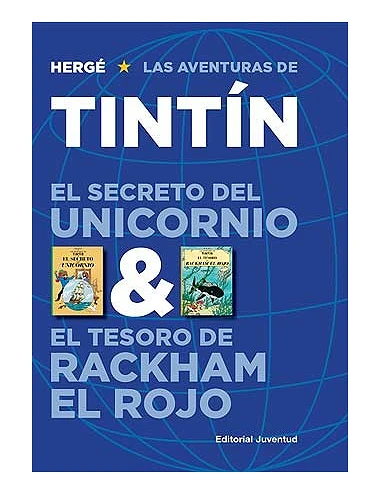
The Secret of the Unicorn & The Treasure of Rackham the Red (Double Album)
Tintin buys a model of an old galleon at the old market. It turns out to be a replica of the ship that governed the ancestor of Captain Haddock, the knight Hadoque, who fought against the pirate Rackham the Red, who carried on his ship a great treasure that has been hidden for centuries. This book includes the two albums of Tintin's adventures, The Secret of the Unicorn and The Treasure of Rackham the Red, in a single volume.
Measurements: 19.5 x 26 cm
Cardboard
128 pages
Languages available:
English
A meteorite is heading towards the earth and many are predicting the end of the world. Tintin goes to the astronomical observatory where he meets Professor Calys. Fortunately, the omens are not fulfilled and only a fragment of the meteorite reaches the earth, falling into the Arctic Ocean. When he notices the presence of an unknown element, Professor Calys organizes an expedition on the ship Aurora, in which Tintin and Captain Haddock take part. The Shooting Star will be the first album already designed in color and was published in 1942.
Translated by Concepción Zendrera
23 x 30 cm
Cardboard
64 pages
This album marks a return to adventure. It begins to appear in the weekly Tintin, in September 1966, four years after the end of The Castafiore Emerald. Here we meet again Rastatopoulos, whom we thought drowned at the end of The Red Sea Sharks, and his friend Allan. A new figurine appears: the very rich Lazlo Carreras, the man who never laughs. Carreiras is a millionaire owner of airairplanes, oil companies and the Sani-Cola beverage. This character was inspired by Marcel Dassault. He is a paradoxical character: he is among the good guys, but under the effect of the truth serum he is portrayed as a being without scruples when it comes to having amassed his fortune. Towards the end of the story we discover Mik Ezdaditoff, a character inspired by Jacques Bergier, author of the book Le Matin des magiciens and animator of the magazine Planète. We see here Hergé's fascination with paranormal and extraterrestrial phenomena.
Translated by Concepción Zendrera
23 x 30 cm
Cardboard
64 pages
The publication of the adventures of Tintin, reporter of the Petit Vingtième in the land of the Soviets, began on January 10, 1929 in the children's supplement of the Belgian newspaper Le Vingtième Siècle, in the form of single pages, in black and white as the present edition. In 1930 they were expanded in an album with which Hergé started the collection of the Adventures of Tintin, showing what in the future would be his way of doing both in drawings and in scripts and "gags", and that he would perfect in the following adventures.
Translated by Concepción Zendrera
23 x 30 cm
Cardboard
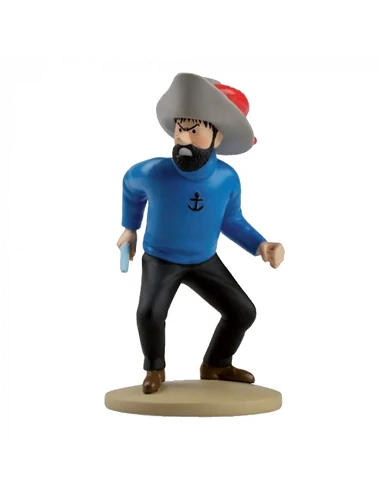
Collectible TF1 Tintin resin figurine - HADDOCK AS HADOQUE 42232 (2021)
This resin figurine is that of Captain Haddock when he is telling Tintin the memories of his ancestor, the knight Sir Francis de Hadoque. The figurine corresponds to vignette D3 of page 13 of the album The Secret of the Unicorn.
Height: 12 cm
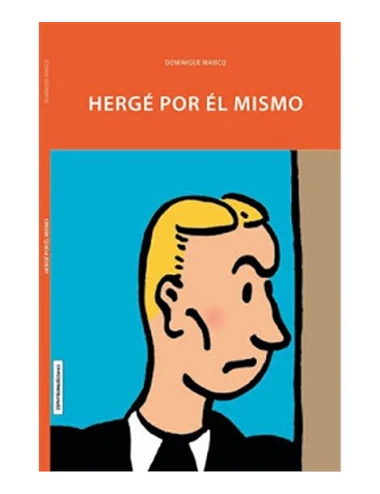
Hergé Por Él Mismo
Portrait Of An Artist Who Was Also A Man: Hergé
Hergé, one of the greatest artists of the 20th century said:
"Tintin was born out of my unconscious desire to be perfect, to be a hero."
What most people ignore is that Hergé handled the pen as well as the brush. A thorough study of Hergé by Dominique Maricq, author of other books such as Les trésors de Tintin. This biography reviews the personality of Georges Remi from letters of correspondence, interview statements or anthologies of his work. The book reveals a man rich in ideas, concepts, thoughts, with a tender humor and full of love and friendship.
Paperback
Language: Spanish
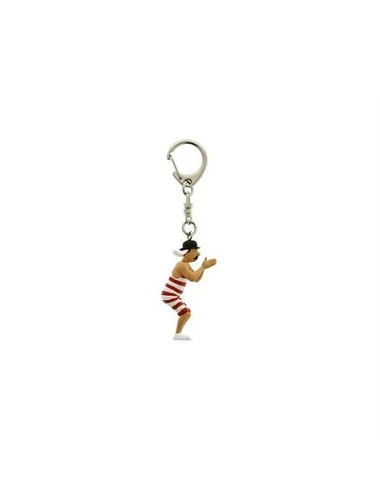
Tintin PVC keychain - Thomson Swimsuit - 5,5CM
Small PVC Thomson keychain with a striped swimsuit in Tintin in the Land of Black Gold.
Characteristics:
Measurements: 5.5 cm
Material: PVC
This work began to be published in the weekly magazine Tintin on March 30, 1950, nineteen years before the arrival of man on the moon. It is not science fiction but an anticipation as accurate as possible. Hergé contacted Dr. Bernard Heuvelmans, author of the book L'homme parmis les étoiles (Man Among the Stars), a specialist on the subject, who collaborated with the team. An extraordinary model of the rocket was made and submitted for the approval of Ananolf, author of the book Astronautics. It was entirely dismountable and allowed the young Bob de Moor, who was mainly responsible for the scenery, to know where the characters were in the spaceship at all times. Hergé has the grace to give a humorous tone to all the scenes of scientific explanations that could bore the reader. Thus, when Wolf and Professor Calculus explain more or less complicated elements, Captain Haddock is there to make us smile with his replies.
Translated by Concepción Zendrera
23 x 30 cm
Cardboard
64 pages
This comic masterpiece, published in 1944, is the continuation of 'The Secret of the Unicorn' and tells the story of the search for the treasure of the pirate Rackham the Red. Professor Calculus enters the scene, the endearing scientist inventor, wise and absent-minded, whom we will meet again in the following adventures of Tintin, and who will become one of his good friends.
Translated by Concepción Zendrera
23 x 30 cm
Cardboard
64 pages